
EDR/XDR integration connects Portnox Cloud’s network access control with endpoint detection tools like CrowdStrike and SentinelOne, so device posture and threat signals inform access decisions in real time. Rather than treating endpoints and network access as separate systems, Portnox enforces pre-connect policies, like confirming antivirus is current or a firewall is active, before a device reaches the network, then can automatically restrict access if EDR/XDR flags a compromise afterward.
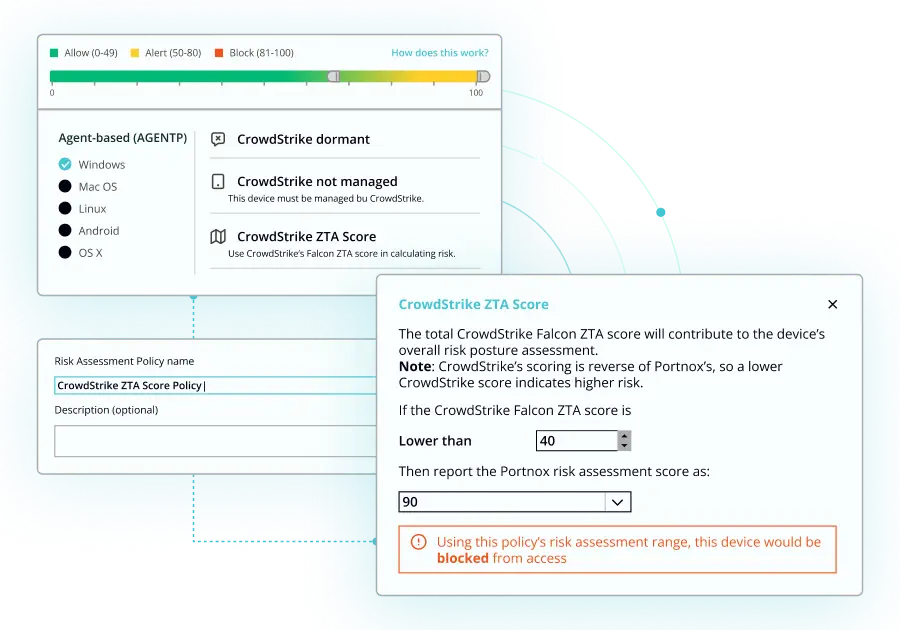
EDR/XDR solutions like CrowdStrike and SentinelOne are built to deeply analyze endpoint behavior, detect anomalies, and alert administrators to stop attacks in real time — while also correlating data across your environment for a complete threat picture. As part of your security infrastructure, Portnox enforces critical pre-connect policies — such as verifying up-to-date antivirus or ensuring firewalls are active — before a device can access your network. Through integrations with platforms like CrowdStrike and SentinelOne, Portnox unites your essential security tools, enabling coordinated threat detection, response, and policy enforcement to keep your organization secure.
With Portnox, you get a powerful risk policy engine that automatically calculates a dynamic risk score for every endpoint. Our platform goes beyond the standard Deny/Allow/Quarantine model by enabling corrective actions — such as stopping or starting services, uninstalling applications, and more — to proactively reduce risk. Through integrations with leading EDR/XDR solutions like CrowdStrike and SentinelOne, you can leverage advanced machine learning and real-time endpoint telemetry to strengthen threat detection and response.
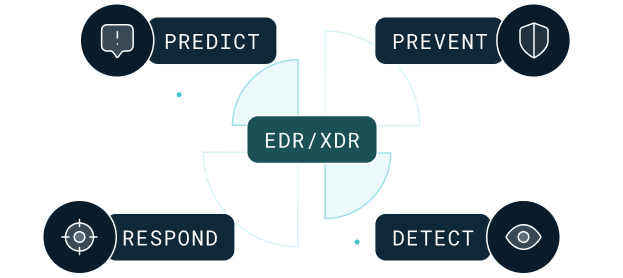
EDR/XDR
EDR (Endpoint Detection and Response) monitors endpoints to detect suspicious behavior, investigate threats, and support response actions like isolation or remediation. Portnox Cloud complements EDR by enforcing access control based on device posture and risk, helping keep compromised endpoints off the network before they can act.
XDR (Extended Detection and Response) expands beyond endpoints to correlate telemetry across networks, cloud, and identities. EDR focuses on endpoint activity; XDR adds broader context. Portnox Cloud strengthens XDR outcomes by adding identity and device-level access context, including authentication activity and enforcement events.
Portnox Cloud shares access and device context, authentication events, compliance status, and enforcement outcomes, with your EDR/XDR platform. This lets security teams correlate endpoint detections with real network access activity, speeding up triage and giving investigators a fuller picture of what happened.
When an integrated EDR/XDR tool flags risk, Portnox Cloud can automatically restrict or revoke that device’s network access without waiting on manual review. This closes the gap between detection and containment, so a compromised endpoint can’t move laterally while a security team is still investigating.
Portnox Cloud contributes signals like user authentication attempts, device identity and type, posture and compliance state, and access decisions (allowed, restricted, quarantined, blocked). These connect endpoint detections to the access story: who connected, from what device, and what access was actually granted.
Yes. Portnox Cloud adds policy context and device compliance status to raw endpoint alerts, so teams can quickly see whether a flagged device was trusted, compliant, and granted access. That context improves prioritization and cuts down on noise.
Portnox Cloud verifies identity and device posture before granting access, then keeps enforcing policy as risk changes. EDR/XDR detects and investigates threats after the fact; Portnox helps stop risky endpoints from reaching sensitive systems in the first place.
Yes. Portnox Cloud has out-of-the-box integrations with CrowdStrike, SentinelOne, and Absolute, so you can enforce pre-connect policies, like confirming an active EDR agent or up-to-date antivirus, using the EDR/XDR platform you already run.
Portnox Cloud delivers cloud-native access control without the complexity of on-prem appliances and constant maintenance.
Get full visibility into every device, enforce policies automatically, and adapt access based on real-time posture and risk. The result is stronger security, simpler operations, and effortless scalability across your entire environment.


After completing the form, an email will be sent to you with the report download link.


