
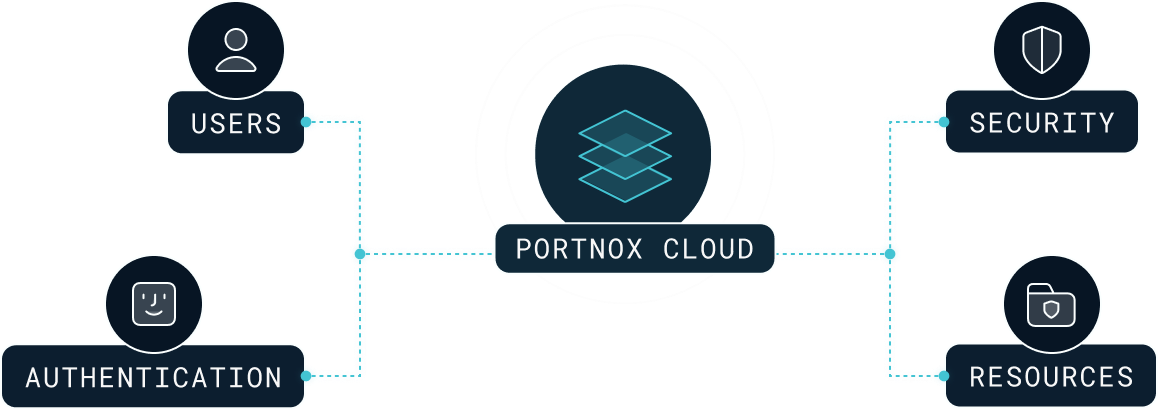
IAM integration connects Portnox Cloud to identity providers like Microsoft Entra ID, Okta, and Google Workspace so network access decisions are based on verified user identity and role, not shared passwords. With Portnox’s IAM integrations, you replace risk-prone passwords with certificate- and identity-based authentication, making it easier to manage access for an on-the-move workforce no matter where they connect from.
Leverage your directory groups to create role-based access control policies to ensure that only the people have access to specific parts of the network, and prevent lateral movements across the network that could open the door to would-be threat actors.
Identity & Access Management Integrations
IAM is a framework of policies and technology that ensures the right users and devices get the appropriate level of access to systems, applications, and networks. Platforms like Microsoft Entra ID, Google Workspace, and Okta centralize this authentication and authorization.
IAM integrations let network security tools use centralized identity data to make access decisions. Integrating IAM with network access control lets organizations enforce identity-based policies, cut reliance on shared credentials, and limit network access to only authenticated, authorized users and devices.
IAM integrations are foundational to zero trust because they verify identity before granting access. Paired with Portnox Cloud’s NAC, that IAM data is continuously re-validated, so access is granted based on identity, role, and policy, not network location.
Password-based IAM integration still authenticates users with credentials that can be phished or shared. Certificate-based integration, which Portnox Cloud supports alongside IAM platforms like Entra ID and Okta, issues a unique digital certificate per device instead, removing the password as an attack vector entirely.
Portnox Cloud integrates with IAM platforms like Microsoft Entra ID, Okta, and Google Workspace to apply identity-driven access decisions the moment a device connects. Using attributes like user role, group membership, and authentication status, Portnox enforces dynamic policy across wired and wireless networks based on verified identity, not just network location.
Yes. Portnox Cloud uses IAM roles and group membership to automatically assign access privileges by user, making least-privilege access easy to apply across employees, contractors, and guests. Policies apply consistently org-wide without manual network configuration.
IAM is the broader framework for managing identity, authentication, and authorization across an organization. SSO is one feature within IAM that lets a user log in once to access multiple applications. Portnox uses IAM data, including SSO status, to make network access decisions.
Yes. Portnox Cloud has out-of-the-box IAM integrations with Microsoft Entra ID, Active Directory, Okta, Google Workspace, and JumpCloud, so you can apply identity-based access policies using the directory you already run, without adding a separate identity system.
Switching to Portnox Cloud lets you replace complex, on-prem access control tools with a cloud-native platform that’s faster to deploy, easier to manage, and simpler to scale across every location.
You gain stronger security through real-time device visibility, automated policy enforcement, and continuous posture checks—without the infrastructure overhead or maintenance burden of legacy NAC.

Modern, cloud-based NAC securing wired and wireless access with instant device discovery, posture validation, and automated enforcement.

Cloud-native, posture-aware access delivering secure, passwordless connectivity to SaaS and private apps without VPN complexity.
After completing the form, an email will be sent to you with the report download link.