
Manufacturing has been the most-targeted industry five years running, and ransomware attacks are up 56% year over year. Aging OT, sprawling vendor access, and tools blind to the plant floor mean one attack can halt a line. Portnox gives you visibility and control over every device and identity across IT and OT, revokes vendor access the moment the job is done, and keeps every plant enforcing policy even offline. No new hardware, agents, or headcount.

Trusted by Leading Financial Institutions


The Challenge
A device inherited from a systems integrator years ago. A contractor’s laptop that still has standing VPN access from a project that ended in 2023. A PLC running Windows 7 that can never be patched or agented because it’s under OEM warranty. None of this is visible to tools built for corporate IT, and none of it stops being a target. Manufacturers need visibility and enforcement that spans both sides of the IT/OT line, not two separate tools that don’t talk to each other.
Plant-floor equipment running Windows 7 or XP under OEM warranty was never built to be patched or agented, but it's exposed to the same attackers hitting corporate IT.
Integrators, OEM techs, and contractors need access to specific equipment on demand. Most environments still hand out shared VPN credentials that never expire.
Cisco ISE and Aruba ClearPass were built for corporate wired and wireless, not plant-floor device diversity. Most manufacturing deployments get stuck in monitor mode for years.
Profiles and enforces policy on every device, including legacy OT and PLCs, without installing anything on equipment that can't take an agent.
Gives every contractor and OEM service tech access to exactly the equipment they're there to touch, automatically revoked when the work order closes.
Unifies visibility and enforcement across every plant in one console. Local RADIUS keeps enforcing policy even if the connection to the cloud drops.

Legacy access control was designed for badge-in employees on a corporate network. It wasn’t designed for the integrator who needs into the line at 2am, the OEM tech dropping in for a single service call, or the six plants each running their own inconsistent RADIUS deployment. That’s where the gap lives, and where one compromised vendor credential can turn into a halted line.
Portnox gives every contractor, integrator, and OEM service tech access to exactly the equipment they’re there to touch, automatically revoked when the job’s done. No shared VPN credentials. No standing access to your OT network long after the work order closes.
Manufacturers face more contractual and regulatory pressure on access control than most industries realize. CMMC 2.0 certification is now a contract gate for defense-adjacent business: no cert, no bid. Cyber insurance carriers increasingly require device inventory and segmentation evidence before binding a policy. OEM customers are sending security questionnaires manufacturers keep failing. Portnox gives you the enforcement and audit trail to answer all three with evidence, not a policy document.
For manufacturers in the defense supply chain, CMMC 2.0 certification isn’t optional. It’s the gate that determines whether you can bid at all. Portnox maps directly to the access control and network segmentation families examiners look for, giving you continuous evidence instead of a point-in-time snapshot.
Carriers now require device inventory and network segmentation evidence before they’ll bind or renew a policy, and manufacturing’s OT-heavy environments make that hard to produce on demand. Portnox gives you a continuous, exportable record of every device and access decision across every plant.
Every OEM relationship now comes with a security questionnaire, and vague answers about vendor access and device visibility cost deals. Portnox gives you a defensible, documented answer for how access is granted, monitored, and revoked across your plants.
Manufacturers handling Controlled Unclassified Information (CUI) must demonstrate access control and identification/authentication practices under NIST 800-171, the same control families CMMC 2.0 is built on. Portnox enforces least-privilege access and produces the audit trail assessors ask for.
Portnox helps manufacturers move beyond point-in-time device audits. Access is continually evaluated based on identity, device posture, and risk, across every plant, from one console.

Secure users, vendors, machines, and OT devices across every plant

Restrict, quarantine, or auto-revoke access the moment a contract ends or a device falls out of compliance

Replace legacy NAC and inconsistent per-plant RADIUS deployments with one cloud-native console

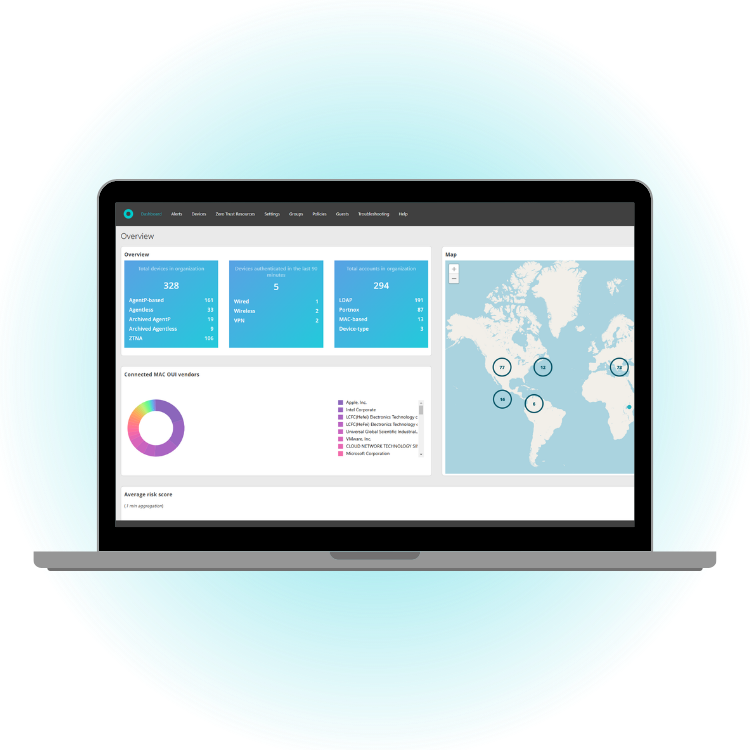
Gain visibility into every device connected to the network, IT and OT alike, agentless

Enforce policy locally at every plant, even when the connection to the cloud drops
Unify audit trail and reporting across every site and access layer
Built for Manufacturing
Manufacturers operate lean IT teams (often 3–8 people across multiple sites) and can’t afford access control that slows production or leaves gaps an OEM questionnaire will catch.
Portnox deploys without touching equipment that can’t be touched, and manufacturers use it to:
Independently verified
Lower Breach Risk*
Reduced Networking Costs*
Payback Period*
Maintenance hours reclaimed*
The Total Economic Impact(TM) Of Portnox Cloud, a commissioned study conducted by Forrester Consulting, December 2025. Results are based on a composite organization representative of interviewed customers.

Manufacturing has been the world’s most attacked industry for five consecutive years, and the pressure is no longer only from attackers. Customers now audit supplier access controls before they place orders, and a failed questionnaire costs a contract rather than a fine. Both audiences ask the same question: who and what is on your network, what can they reach, and should that still be true? Most manufacturers cannot answer quickly, for reasons specific to this industry.
Manufacturing networks increasingly blend corporate IT with operational technology (OT): PLCs, sensors, HMIs, and legacy industrial controllers that were never designed to be visible to a security tool, let alone patched or agented. Portnox Cloud closes this gap with agentless device profiling and fingerprinting that identifies and classifies every device connecting to the network, IT and OT alike, without installing anything on equipment that can’t take an agent. Once identified, Portnox enforces segmentation policies that isolate OT devices from corporate systems, limiting the blast radius of any single compromised device. This gives lean manufacturing IT teams, often 3 to 8 people covering multiple plants, a single console for visibility and enforcement across environments that used to require separate, disconnected tools.
For manufacturers that sell into the defense supply chain, CMMC 2.0 certification has become a hard contract gate. Without it, a business can’t bid. Portnox Cloud maps directly to the access control, identification and authentication, and system/communications protection control families that CMMC 2.0 assessors evaluate, enforcing least-privilege access and network segmentation across every plant. Because Portnox is cloud-native, manufacturers don’t need to deploy hardware at each site to get consistent enforcement. Continuous access logs and posture data give compliance teams audit-ready evidence rather than a point-in-time snapshot, which is increasingly what CMMC 2.0 assessors and cyber insurance underwriters are both asking to see.
Vendor access is one of the largest blind spots in manufacturing security. Integrators, OEM service technicians, and contractors typically need access to specific equipment for a single visit, but most plants still rely on shared VPN credentials that are rarely revoked once the job is done. Portnox Cloud enforces identity- and role-based access that gives each vendor reach to exactly the equipment they’re there to service, automatically revoked when the work order closes. There are no standing credentials left behind, and no shared logins to track down after the fact, reducing one of the most common paths ransomware takes into converged IT/OT environments.
Much of the equipment on a plant floor, including PLCs, HMIs, and controllers running Windows 7 or XP under OEM warranty, physically cannot run a security agent and often can’t be touched without voiding a service contract. Portnox Cloud is built agentless from the ground up, using passive, monitor-mode-first profiling to identify and classify these devices without installing anything on them. For devices that will never support 802.1X or run a supplicant, Portnox uses MAC Authentication Bypass (MAB) combined with device fingerprinting to bring them under policy enforcement anyway, so legacy equipment doesn’t stay invisible to the network just because it can’t be modernized.
Legacy NAC platforms like Cisco ISE and Aruba ClearPass were built for corporate wired and wireless networks, not plant-floor device diversity, and many manufacturing deployments get stuck running in monitor mode for years because full enforcement is too disruptive to production. Forescout offers strong agentless device visibility but is typically deployed alongside a separate RADIUS or 802.1X platform, leaving manufacturers to manage two consoles instead of one. Portnox Cloud unifies visibility and enforcement, including NAC, RADIUS, and policy, in a single cloud-native platform, with no on-premises hardware, no per-plant appliance, and no added headcount to run it.
Manufacturing sites can’t treat a dropped connection as a reason to fail open on security. Portnox Cloud’s local RADIUS capability keeps every plant enforcing access policy even when connectivity to the cloud is interrupted, so a temporary outage never becomes a window for something risky to connect unchecked. This matters most for multi-site manufacturers who’ve historically run six plants on six inconsistent RADIUS deployments. Portnox lets them standardize policy centrally while each site keeps enforcing locally and independently.
See how Portnox helps manufacturers secure access across users, devices, vendors, machines, and every plant in the network.
After completing the form, an email will be sent to you with the report download link.