
Financial institutions can’t rely on one-time access decisions. A trusted device can fall out of compliance, a vendor’s access can become risky, or an AI agent can reach systems it shouldn’t. Portnox helps enforce access policies in real time, so access can be limited or removed when trust changes.

Trusted by Leading Financial Institutions


The Challenge
A compliant device can fall out of compliance. A contractor may no longer need access. A certificate expires. An AI agent reaches systems it shouldn’t. Static controls weren’t built for any of this. Access needs to be continuously reviewed and enforced, not approved once and forgotten.
Access is approved once and not revisited, leaving risk undetected until after the damage is done.
Contractors, vendors, machines, service accounts, and AI agents all need the right access. Most tools weren't built for this reality.
Built for network admission only. Modern environments require enforcement across apps, infrastructure, and remote access.
Evaluates access continuously based on identity, posture, and risk — not just at the point of entry.
Governs access for every identity type — human, machine, and AI — from a single policy engine.
Portnox unifies network, application, and infrastructure access in one cloud-native platform — no hardware required.

AI agents are identities
Legacy access control was designed for humans logging in. AI agents don’t log in — they run continuously, touch sensitive systems, and almost never get governed the same way. That’s the gap.
In financial environments, AI agents need the same governed access as any other identity. Portnox helps financial institutions unify user, device, vendor, machine, and AI agent access enforcement.
Financial institutions face more regulatory pressure than almost any other sector. Portnox gives you the access controls, audit trails, and continuous enforcement that regulators expect, in one access control platform. Whether you’re facing a NYDFS exam, a DORA audit, or a PCI DSS assessment, Portnox gives you evidence, not just policies, of your environment’s operational resilience.
YDFS examiners want proof your controls are working. The 2023 amendments raised the bar on access control, MFA, and network segmentation, and enforcement has teeth.
Portnox gives your team a continuous, auditable record of every access decision, so you walk into an examination with confidence instead of spreadsheets.
With GLBA, the examiner’s focus is access. Specifically, whether the right people can reach customer financial data and, more importantly, whether the wrong ones can’t.
Third-party and vendor access is where most gaps live. Portnox gives you continuous visibility and control over every identity that touches sensitive data, with an audit trail that maps directly to Safeguards Rule requirements.
With PCI DSS, the battle is scope. The smaller and more tightly controlled your cardholder data environment, the smaller your attack surface and assessment burden. The risk is when devices that shouldn’t be able to reach payment systems can do so.
Portnox enforces and continuously validates network segmentation and automatically quarantines anything that falls out of scope before your QSA finds it.
SOX Section 404 auditors are testing one thing above all: whether unauthorized users can reach the systems that produce your financial reports. Over-privileged accounts and missing access reviews are the most common findings.
Portnox gives IT and compliance teams a continuous, auditable record of who accessed what, so access reviews are a report pull, not a manual exercise.
NCUA ACET examiners score your cybersecurity maturity across domains, and access control is one of the most heavily weighted. The question isn’t just whether you have policies; it’s whether you can demonstrate they’re working across every branch, device, and user on your network.
Portnox gives credit unions the continuous enforcement and audit-ready evidence to score with confidence, not scramble before exam day.
Portnox helps financial institutions move beyond one-time access approvals. Access is continually evaluated based on identity, device posture, policy, and risk, so teams can respond when something changes.

Secure users, vendors, devices, machines, and AI agents

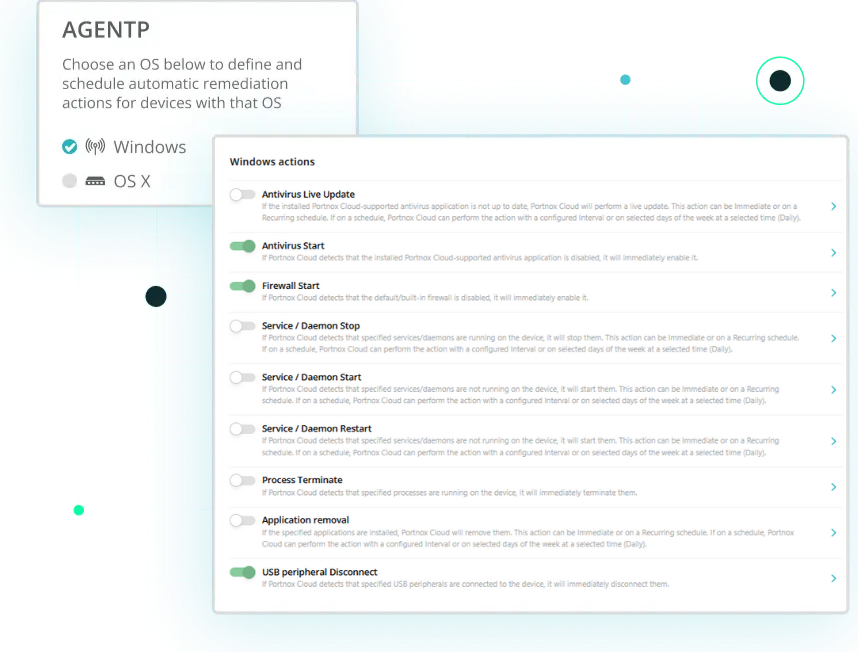
Restrict, quarantine, or remove access automatically when requirements aren’t met

Replace legacy NAC and RADIUS complexity with cloud-native control

Gain visibility into access decisions, device status, and policy enforcement

Replace broad VPN access with zero trust application access

Unify audit trail across every access layer
Built for Financial Services
Banks, credit unions, and payment processors operate complex, distributed environments — and can’t afford access control that slows IT down or leaves gaps auditors will find.
Portnox deploys in days and works with your existing infrastructure. Financial institutions use it to:
Independently verified
Lower Breach Risk*
Reduced Networking Costs*
Payback Period*
Maintenance hours reclaimed*
The Total Economic Impact(TM) Of Portnox Cloud, a commissioned study conducted by Forrester Consulting, December 2025. Results are based on a composite organization representative of interviewed customers.

When auditors mandated NAC compliance across 14 branch locations, one financial services organization needed a solution that could move at audit speed — not at the pace of a hardware deployment. Portnox NAC delivered.

PCI DSS requires organizations that process, store, or transmit cardholder data to implement strict access controls, network segmentation, and continuous monitoring. Portnox Cloud directly supports these requirements by enforcing identity- and device-based access control policies, ensuring only authorized users and compliant endpoints can reach cardholder data environments (CDEs). Portnox enables granular network segmentation to isolate CDEs from other parts of the network, limiting the blast radius of any potential breach. Real-time endpoint posture checks verify that connected devices meet PCI DSS security requirements — including up-to-date patches, active antivirus, and encryption. Detailed authentication logs and access reports generated by Portnox support audit readiness and help organizations demonstrate compliance during QSA assessments. For financial institutions managing payment card data across distributed branch networks, Portnox delivers the continuous visibility and enforcement that PCI DSS demands without requiring hardware-dependent infrastructure.
The Sarbanes-Oxley Act (SOX) requires public companies to implement strong internal controls over financial reporting, including controls that restrict and monitor access to systems that process or store financial data. Portnox Cloud supports SOX compliance by enforcing least-privilege access policies across networks and infrastructure, ensuring that only authorized personnel can access systems relevant to financial operations. Through its TACACS+ functionality, Portnox provides detailed accounting logs of administrative activity on network devices — a requirement for demonstrating internal controls to SOX auditors. Real-time endpoint risk monitoring identifies anomalous behavior and non-compliant devices before they can introduce risk to regulated systems. Centralized access reporting gives security and compliance teams the evidence they need to demonstrate that access to financial systems is properly controlled, monitored, and auditable — reducing the burden of manual compliance documentation and audit preparation.
Banks and credit unions operate highly distributed environments — dozens or hundreds of branch offices, each with their own wired and wireless infrastructure, teller workstations, ATMs, and customer-facing devices. Portnox Cloud is purpose-built for distributed networks, delivering cloud-native NAC that requires no on-premise hardware or RADIUS servers at each location. Security and IT teams can enforce consistent access control policies across every branch from a single cloud console, ensuring that only authorized devices and users can connect to the network — whether in headquarters or a remote location. Portnox also provides real-time device visibility and posture assessment, automatically quarantining endpoints that fall out of compliance. For institutions managing tight IT staffing ratios across many sites, this centralized control dramatically reduces complexity while maintaining the access control rigor that bank regulators and internal auditors expect.
The EU’s Digital Operational Resilience Act (DORA) establishes binding requirements for financial entities to manage ICT risk, ensure operational resilience, and maintain security controls across their digital infrastructure. Portnox Cloud supports DORA compliance by providing continuous visibility into network-connected endpoints and enforcing real-time access control policies that reduce the attack surface. By validating device posture and identity before granting access, Portnox limits the ability of unmanaged or compromised devices to introduce risk into critical financial systems. Network segmentation capabilities help isolate critical operations from less-sensitive parts of the infrastructure, supporting DORA’s requirements for ICT risk containment. Portnox’s detailed access logs and policy enforcement reporting support the ICT incident reporting and documentation requirements embedded in DORA. For financial institutions operating across the EU, Portnox offers a scalable, cloud-native path to meeting DORA’s access control and risk management expectations.
Insurance companies rely heavily on a distributed workforce — field agents, adjusters, underwriters, and third-party contractors who regularly connect personal or unmanaged devices to corporate networks and applications. This creates significant exposure if access is not properly governed. Portnox Cloud enforces BYOD security policies by assessing device posture at the point of connection and applying access controls based on device compliance status — without requiring agents to be installed on personal devices. Unmanaged or risky endpoints can be automatically quarantined or redirected to a limited-access network segment, preventing them from reaching sensitive policyholder or claims data. For contractors and guests, Portnox enables secure, role-based access that limits connectivity to only the resources they need. This zero trust approach ensures that third-party access doesn’t become a liability, while reducing the friction that traditionally comes with BYOD management in large, distributed insurance organizations.
Fintech companies face a uniquely complex compliance landscape — often navigating PCI DSS, GLBA, SOC 2, and state-level data privacy regulations at the same time, while scaling rapidly and managing hybrid cloud infrastructure. Portnox Cloud provides a unified access control platform that supports multiple frameworks simultaneously through consistent policy enforcement, real-time device visibility, and centralized compliance reporting. Rather than deploying separate tools to address each regulatory requirement, fintech security teams can use Portnox to enforce least-privilege access, validate endpoint posture, and generate audit-ready logs that satisfy multiple frameworks from a single platform. Portnox’s agentless architecture and cloud-native deployment model mean it scales alongside fintech growth — without the complexity of legacy NAC appliances. For fintech companies under investor, customer, and regulatory scrutiny, Portnox provides a defensible, documented security posture that demonstrates compliance maturity across frameworks.
Financial institutions operate a wide range of IoT and operational technology (OT) devices — from ATMs and card readers to surveillance systems, HVAC controls, and smart building infrastructure. These devices are often unmanaged, cannot run security agents, and are difficult to monitor with traditional tools. Portnox Cloud addresses this through agentless device profiling and fingerprinting, automatically identifying and categorizing IoT devices as they connect to the network — without requiring any software installation on the device itself. Once identified, Portnox enforces segmentation policies that isolate IoT devices from sensitive financial systems, limiting the risk of lateral movement in the event of a compromise. Real-time posture monitoring continuously evaluates connected devices for anomalous behavior. For financial institutions managing a growing fleet of edge devices across branch locations, Portnox delivers the visibility and enforcement needed to protect IoT-rich environments without adding operational overhead.
Passwords are one of the leading causes of data breaches in financial services — compromised credentials are frequently exploited to gain unauthorized access to sensitive systems. Portnox Cloud enables financial institutions to move toward passwordless authentication using certificate-based access control, replacing password dependency with cryptographic credentials that are far harder to steal or phish. Certificates are issued and managed through Portnox’s cloud-native PKI infrastructure, eliminating the need for a separate on-premise certificate authority. Employees authenticate seamlessly using their device certificates, reducing friction while significantly improving security posture. This approach supports both network access (via 802.1X/EAP-TLS) and application access, extending passwordless security across the full environment. For financial institutions subject to regulators and auditors scrutinizing authentication controls, Portnox’s certificate-based approach provides a well-documented, standards-based mechanism that strengthens compliance posture and reduces credential-related breach risk.
Financial services organizations are rapidly deploying AI-powered tools, automation workflows, and machine-to-machine integrations — all of which introduce non-human identities that need access to sensitive systems and data. Unlike human users, AI agents and automated services often operate continuously, at scale, and without the kind of manual oversight that governs human access. Portnox Cloud extends zero trust access control principles to non-human identities, enforcing policy-based access controls that ensure AI agents and automated processes can only connect from authorized endpoints under defined conditions. Real-time posture checks validate the integrity of the systems running AI workloads, and network segmentation limits the blast radius if an AI-adjacent system is compromised. As financial regulators begin scrutinizing AI governance more closely, Portnox’s ability to enforce and log access by non-human identities gives security and compliance teams a defensible record of how AI systems are interacting with the network.
One of the most common objections financial services IT and security teams raise about NAC is the complexity and time required to deploy it. Legacy NAC solutions often require hardware appliances at each location, lengthy professional services engagements, and months of configuration before enforcement can begin. Portnox Cloud is designed differently. As a cloud-native platform, it requires no on-premises hardware and can be deployed across distributed financial environments — including branch networks, data centers, and remote endpoints — in days rather than months. Portnox integrates directly with existing identity providers (Active Directory, Entra ID, Okta), MDM platforms, and SIEM tools, reducing the configuration burden significantly. Most financial services organizations begin enforcing real access control policies within their first week of deployment. The Forrester Total Economic Impact study of Portnox Cloud found that organizations achieved a payback period of under six months — a compelling timeline for institutions managing tight security budgets alongside active compliance obligations.
After completing the form, an email will be sent to you with the report download link.